Love is life and the end of it, A cradle of happiness and the sorrow bit, Love is a medicine and that painful fit, As spring is to a flower, monsoon to the wood it split.
Inspires you to keep moving while asking to stay, Teaches you to be loyal while repaying with dismay, Source of your delights and the miserable day, Yet, love is a craving, an ambivalence leaving you astray.
When did a laugh of joy in public start to feel awkward. When did a cry of sorrow become the only thing that lifts stone off the heart. When did the blushful smile of a new idea turn to the stress of survival. When did the delicious shiver of a ghost story turn to the cold dread of falling behind. When did peace start to mean personal space over a family picnic. When did curiosity to learn turn to settling for whatever job we get.
I never thought I’d envy young kids — the way they feel things, fully, the way they were meant to be felt.
I used to think experience taught us how to live. Turns out the children already knew.
One thing we all hear when we face failure or get put down – “It’s not the the end of the world.“
Well, if you’re in one such situation today, here’s what you really need to hear.
Forget those people. It shouldn’t matter to you if it is the end of the world or not. ‘Cause what matters is YOU.
Live for yourself. Learn for yourself. Keep going for yourself. If you won’t live for you, then who would?
So if today feels heavy as if you failed, going through a bad phase, or plain hurting, remember this: It is not the end of you.
You still have countless successes and setbacks ahead. Wins and losses. Achievements and sacrifices. Chances to stand for something and chances to redefine yourself.
Philosophers: “When life gives you lemons—make lemonade.“
Rest of the world: When life gives you lemons— Monetize it. Brand it as 100% natural product. Market the shit out of it and sell globally. Call yourself successful. Pose as a selfless person on the web who only lives to serve others. And start posting “original quotes” like hard work is the only key to success. 🍋
After all, we were born to learn the value of money, to take innovation to the next level. 🫠
Let’s paint a picture. After a hectic work week, the weekend is finally here. You want to make the best of this little free time and stop thinking about the developer who hasn’t shared the final code, or the leader who still hasn’t approved your email.
You’re eating breakfast, wondering what you’d like to do today. Movie? That long overdue book? A fancy lunch? A coffee and music session? Bowling or cricket with friends? Or just stay home and sleep all day?
The list is always long, isn’t it. And your first goal isn’t really any one of those activities. It’s to make the most of this break. The pressure is real.
We meet this every day in some or the other way. Choosing a restaurant to order from, which shoes to buy, where to invest money for the best returns. Well, my favorite work function is here to save the day again. Project management offers elegant decision-making techniques, not only to lead a project to success but to lead a satisfied personal life too. You can use them to plan a weekend, build a daily routine, even structure your office hours for better output. Some help you take a decision yourself. Some help you hand it to someone with better judgement.
What will this cost you? (skill I)
It’s a fresh Saturday morning. Your best friend has been inviting you to visit this new club in Gurugram for a month, but you keep delaying it for being too far. This weekend they call you again and put you in the middle of a decision.
Only this time, one thing’s different. You’ve read about a technique called Three-Point Estimating. Instead of guessing one number, it asks you to estimate the same thing three times: optimistic, most likely, and pessimistic.
A club is best visited during late evenings. You stay in Delhi and will be taking a cab to Gurugram. Optimistically, with minimal traffic, the ride would take about 60 minutes. Most likely, based on past rides, about 90 minutes. But this being the weekend, it might stretch to 150 minutes in heavy traffic.
Three perspectives, three values. The technique gives you a simple formula to arrive at an expected value:
(Optimistic + 4 x Most Likely + Pessimistic) / 6
Using the values we came up with, that’s 95 minutes as the expected time it will take.
Now, 95 minutes is the middle of the range, which means you’d be late about half the times you make this trip. Not much use when you’re telling someone what time you’ll reach. So, the same three numbers give you a second figure, the spread, and it’s just as easy:
(Pessimistic – Optimistic) / 6
That’s 15 minutes here. Add it once to your estimate and you get 110 minutes, a number you’d actually hit around 85% of the time. Notice you didn’t have to guess at a buffer or pad the answer to feel safe. The three numbers you already gave contain both the estimate and how much to trust it.
So: 1 hour 50 minutes each way. A round trip is 3 hours and 40 minutes. Almost four hours of your Saturday, spent inside a cab.
Until now this was a vague feeling over breakfast that the travel would be long. Now it’s a number, and the number is bigger than the feeling was.
But there’s a second cost hiding in those three values, and it’s the one people miss. Your range runs from 60 minutes to 150. That’s not just a long trip; it’s an unpredictable one. You cannot tell your mother what time you’ll be home. You cannot make any plan for after. Four hours you can schedule around is a completely different thing from four hours you can’t, and that uncertainty costs you separately from the travel itself.
This is what finally makes the decision easy. Your friend has been asking for so long, so the visit isn’t in question. Only the shape of it is. You tell them the plan is on, but for Sunday, where you’ll stay the night at their place and travel to office directly the next morning. Same four hours of travel, except now they buy you a whole evening instead of eating one. And if the night stay isn’t possible, tell your friend it’s their turn to come near your place this weekend. 😉
What are you giving up? (skill II)
Unlike the last one, this technique has no formula. It works entirely in your head, more of a psychological game.
Opportunity cost is the value of what you give up in order to choose one option over others. And the cost here isn’t only financial. It’s what you forfeit in any form, emotionally, physically, or economically.
Back to that Saturday morning and the long list. Say you’re a music lover, and what you want most is a decent coffee house, headphones on, favorite rock playlist running. But that means giving up the only spare hours you had for that long overdue book. And the extra sleep you’ve been missing for two weeks with all the office pressure.
So, what do you do? Every option is a good one, and that is exactly why you’re stuck.
Opportunity cost asks you one question: is this worth more than what I’m giving up for it? Is the coffee and rock music worth choosing over the book you’ve been meaning to read? Worth giving up those extra hours of sleep?
Give it a thought, and the answer arrives. You could sure use that book, but what you really want is a light, relaxing weekend, because office has been too stressful lately. And sleeping through the day would leave you lazy, not letting you get out of bed at all, which isn’t relaxing either. The book can wait a week.
So, the good brew and the rock playlist win, and you’re willing to give up the rest for it. You’ll just make sure to reach home timely and sleep early tonight.
Ah, that feels satisfying. Even an overthinker doesn’t need to give this more thought, because you know why you gave up the other choices. That is exactly what considering the opportunity cost earns you. And note that this is a question you ask before you decide. Once you’ve asked it honestly, you’re allowed to stop asking. A cost you’ve weighed and accepted isn’t a cost you owe anything more to.
Should you go on ahead or move on? (skill III)
Say the first half of your Saturday has passed and you decide to watch the new horror release, followed by dinner at your favorite place. Ticket booked, friend told to meet you after. The plan is satisfying…
Well, I don’t mean to ruin your plans, but it has started to rain heavily and stepping out is now a choice to make. You can still make it, but the roads are waterlogged, the cab fare has surged, and you’ll walk in around the twenty-minute mark. Isn’t it frustrating when this happens!
And here’s the part that makes it hard. You paid 1,000 rupees for that recliner seat. Letting it go feels like throwing money away, so something in your head keeps saying just go, you’ve already paid for it.
That sentence is the trap.
This is what we refer to as Sunk Cost in project management. Sunk cost is the cost, be it emotional, physical, or economic, that you have already paid and cannot reverse now. The 1,000 is spent whether you sit in that recliner or stay home. It is gone in both futures, which means it cannot be a reason to pick either one. This technique asks you to base your decision on what the future holds instead of what has already happened.
So, take the ticket out of the calculation and look at what’s actually left.
Go anyway because you paid? That’s the ticket voting, and it doesn’t get a vote. Go because a horror film missing its first twenty minutes is still worth a wet commute and a surged fare? Maybe it is, just make sure it’s the film you’re going for and not the money. Or drop it, make popcorn, put on something at home, and let the goal of a peaceful weekend continue.
Notice that the ticket price didn’t change which of these is best. It only made one of them feel obligatory.
One caution before we move on, because this idea gets misused as often as it gets ignored. Sunk cost is not a license to quit hard things. Having already invested isn’t a reason to continue, but it isn’t a reason to stop either. The honest question is only ever about what’s ahead: if the remaining path still gets you somewhere you want to be, carrying on isn’t a fallacy, it’s just persistence. Most things worth doing feel worst in the middle, and “sunk cost” is a very comfortable name for giving up on them.
While opportunity cost welcomes optimism in your thinking by asking to broaden your mind and consider alternatives, sunk cost protects that same optimism by asking you to let go of what has already happened and not let it affect what’s to come.
Are there more such useful techniques?
Plenty. This is Part 1 of four, each taking a different question you face in ordinary life. This one was about cost. The next two cover what to do first, and how to choose when the options are close. Part 4 asks the one I think most of us get wrong: whose decision is this, actually?
Until then, a small experiment. Next time you’re about to spend an hour on something, ask what else that hour could buy you. Then decide, and tell me in the comments whether the answer surprised you.
Friendship is a single soul dwelling in two bodies. — Aristotle
Aristotle settled for one soul in two bodies. I’m going to hand you three, and by the end of this article, you’ll wonder how you ever managed without them. That’s a promise!
A project manager’s role is a stressful one, and for good reason. You’re expected to manage stakeholders across a broad hierarchy, keep every one of them satisfied, and stay accountable for progress — all at once. One person, expected to have every answer ready, while quietly handling risks and scope creep (yes, those surprise gifts arrive more often than we’d like). You can feel the pressure just reading about it. Imagine holding it.
Picture this.
You’re three months into a six-month project to build a drinking water reminder app and take it live across every app store. You’ve got a cross-functional team of ten, spread fairly across functions and genuinely invested in the work. The backlog holds 500 action items (only!). And then the sponsor makes a dramatic entrance, wanting to know how far along we are and whether their money is being spent well. Questions like:
🤔 How much of the product is actually ready? 🤔 Are resources being used wisely? 🤔 Should we be worried about the timeline? 🤔 The bugs QAs flagged to our engineers — have they been handled?
Not so fun once you picture yourself in that room, is it?
A GIFT TO US ALL
This is where the creations of corporate legends, built for structure and governance, quietly earn their place. I’m talking about project management software: Jira, ClickUp, Asana, Trello, Notion, and plenty more. Here’s the thing. The three best friends I keep mentioning live inside these platforms. You’ve used them a hundred times without ever noticing how much they were carrying. And the best part — they aren’t locked away in fancy PM software. They’re right there in Excel and Google Sheets too. From a plain spreadsheet to a colorful kanban board to a complex list view, these three friends will carry you through understanding, analysis, and decision-making alike.
Without further ado, allow me to introduce you properly.
“Dear reader… meet Sort, Group, and Filter — your most loyal teammates, always on call, and quietly faithful to anyone managing projects, products, or a business.”
“And you three (* sort, group, filter nodding from the corner *) — meet our reader. A brilliant professional who’s about to find out exactly what you can do.”
Now drama aside, let’s take these three seriously.
We reach for them every single day and rarely stop to notice how much they’re holding up. So, let’s fix that one friend at a time, using the water reminder app from earlier.
SORTING
Sorting answers a single question: what comes first? It takes a shapeless pile and gives it an order, i.e., what was a priority yesterday, what’s urgent today, what’s waiting in line. Get it right and your backlog stops being a list and starts being a sequenced plan so resources go where they matter most.
In the app: Sort the 500 items by estimated due date, and the team instantly knows what to pick up first.
Pro tip: Sort on more than one field at once. Sort by due date and impact level — now, even among the urgent items, you can see which ones truly deserve to go first.
GROUPING
Grouping answers a different question: what belongs together? It reveals how work items relate and who owns what, turning a flat backlog into something you can actually hold accountable — just by using the fields already sitting in your data.
In the app: Group the 500 items by their broadest work type. If you’re working in agile, group by Epic and watch related tasks and subtasks fall into place, so you can read the progress of each deliverable at a glance.
Pro tip: Group in layers — first by work type, then by work function. Now you can tell whether an epic with 20 tasks needs several teams or whether one team can carry it solo. When it’s the latter, work moves from To Do to Done far quicker.
FILTERING
Filtering answers the most in-the-moment question of the three: what deserves my attention right now? It cuts through the noise, pulling only what you’re looking for into view and clearing away everything that doesn’t move you toward the outcome you’re chasing.
In the app: Filter the backlog by work type to show only Bugs, and you’ve instantly got a status-backed picture of how many were raised versus resolved — enough to calculate a metric like Open Defect Count.
Pro tip: Stack your filters. Filter by work type to isolate the bugs, then by item creation date — and you’ll spot the ones quietly going stale, still unresolved long after they were raised. Those are the ones that turn into real setbacks when no one’s looking.
Now let’s return to that room where you’re building a drinking water reminder app — except this time you walk in as a project manager who’s just made friends with Sort, Group, and Filter. Same sponsor, same four questions. Let’s watch you handle them.
I. How much of the product is ready?
First, I filter the backlog down to just epics and stories. I leave out the tasks and subtasks, not because they don’t matter, but because they already roll up into the stories above them, and I don’t want to count the same work twice.
Say that leaves me around 50 items that actually represent deliverable scope. Then I filter by status to see how many read “Complete” — say 30, with the other 20 still To Do or In Progress. But I don’t quote the sponsor a headcount, because ten small items and ten large ones aren’t the same thing. Would you agree? Instead, I measure by the effort behind them, and by effort, we’re 60% of the way there. That’s the number I hand him with the honest confidence that we’re still moving.
II. Are resources being used wisely?
This one’s a personal favorite, because the sponsor is really asking two things at once: is his money working the way he intended, and is his team being treated fairly? Idle hands and uneven workloads are the same problem wearing different clothes — both are budget quietly burning. So, I group the work items by the assignee field to see what each of the ten is carrying.
Say three developers hold 3, 5, and 8 tasks. At a glance, that looks unfair to whoever’s got 8. But count is a liar. Look closer and the eight are medium-impact while the three are high-impact. The load balances the moment you weight it by effort instead of counting heads. That’s what I show the sponsor: not just that nobody’s idle, but that nobody’s buried either.
III. Should we be worried about the timeline?
Here’s where all three friends work together. We’re three months in and 60% of the effort is done, so our demonstrated pace is roughly 20% a month. The remaining 40% needs about two months, and we have three. That’s not a hope; it’s a number, drawn straight from work we’ve already delivered.
To pressure-test it, I filter to epics and stories, group them by status, and sort by effort — one clean view that shows whether the pace holds. If the remaining work looks heavier than what we’ve cleared, I flag it now, not in month five. Either way, the sponsor gets the truth early.
IV. The bugs flagged by testers — have they been handled?
After all that, this one’s easy. I filter the backlog to Bugs, then — remember the pro tip — filter again by creation date. That doesn’t just count what’s open; it surfaces the ones quietly going stale, still unresolved long after they were raised. Say one is still there. I check it’s with the right engineer and set its priority by how much damage it can do. That’s the honest answer: the project’s under control, and nothing’s slipping through the cracks unnoticed.
Four questions. Three friends. One backlog that already held every answer.
We just needed to know how to ask…
And that’s the quiet truth of it. Sorting, grouping, and filtering run through everything a project manager does: shaping the backlog, sharing the load fairly, tracking progress, measuring performance, keeping the whole thing transparent. We lean on them constantly and rarely thank them for it.
Which brings me back to Aristotle. One soul, two bodies — that was his idea of friendship. Ours turned out to be one soul in a hundred bodies: the same three companions living inside Jira, ClickUp, a battered Excel sheet, even sticky notes on a wall.
A startup of twelve has them. An enterprise of twelve thousand has them. Whatever you’re managing, wherever you’re managing it — your 3 best friends are already there, waiting for you to put them to work.
I told you at the start you’d wonder how you ever managed without them. So, what are your thoughts?
Every Project or Product Management enthusiast eventually crosses paths with these three beautiful concepts — Waterfall, Scrum, and Agile.
These concepts provide not only new learnings but entirely new ways to shape your thought process. Some fall in love with Waterfall for its structural discipline, while others develop a crush on Agile and its ability to keep work light. Those in a relationship with software or data? Well, they are usually out on a non-optional date with Scrum, set up by their mentors.
Yet, in all my conversations over the years 🤓 — whether interviewing candidates, mentoring PMs, coaching aspiring Project and Program Managers, or reviewing professional resumes 📝 — I have found the following statements to be alarmingly common:
“My area of expertise includes Agile & Waterfall methodologies.“
“My core strengths are Scrum & Agile methods.“
“I use the Agile framework in my workplace.“
“In Agile projects, we use artifacts like Daily Standups and Sprint Backlogs.“
Do you hear such statements often? Or perhaps, do you use them yourself?
What if I told you that every single one of these sentences is absolutely incorrect? Some of you might find this surprising, while the seasoned veterans are likely nodding in agreement.
Let’s see why!
What separates a top-tier Program Manager from an average one isn’t the size of the budget or the type of project they own. It is how they think during execution. It is the way they prioritize action items and how efficiently they command the resources at hand.
Here is the mantra: WATERFALL is the way we plan. AGILE is the way we think. SCRUM is the way we act.
Curious to know the difference? Let me break down the technical side for you—stress-free and simple.
METHODOLOGY. PHILOSOPHY. FRAMEWORK.
These three concepts are often overlooked. Yet, trust them to be the silent architects of your success when given deep thought in the early stages of any project.
Methodology is the sanctuary for those who crave order; who love to keep things organized. It defines a comprehensive, well-structured approach—and it delivers exactly what it promises. A methodology provides a map, detailed processes, procedures, and the specific tools required to reach the destination.
Let’s look at a real-world example as a fun project!
Say, it is your girlfriend’s birthday next week and you are to buy her a present. You open the Amazon app to find the perfect gift. Would you agree that the app builds the road for you step-by-step: from an intuitive search bar to the product selection, to the cart, to the payment gateway, and finally, the delivery tracking. The experience flows in a systematic, non-negotiable manner. And that system is what makes our experience so great that we’re addicted to online shopping.
Does the app allow you to pay for the order before adding the product to the cart?
Does it let you claim the cashback reward before you actually make the purchase?
No. That is exactly what a Methodology offers: An organized system where you follow a pre-determined pattern, leaving no room for loopholes. You can only move to Step B after Step A is complete.
Read these points. If your current way of working matches them, you are using a Methodology:
It provides detailed, step-by-step guidance to manage the project.
It clearly defines phases in a project, strict set of tasks, individual roles & responsibilities, and deliverables.
It comprehensively covers the aspects of management that otherwise keep a manager up at night: from Planning → Execution → Closure.
Which keyword crossed your mind when you read those features?
Take a second. Think about it.
The first concept that likely hit you is Waterfall.
Other methodologies that have ruled industries for decades include PRINCE2, Six Sigma, and Critical Chain Project Management (CCPM).
Haven’t heard of all of them? Don’t worry. Your curiosity will lead you there soon enough. For now, just focus on how Waterfall fits the strict criteria we just defined.
The next brilliant category… Philosophy!
This one is my personal favorite, and I think you will agree on the why.
Philosophy is the way our mind works.
A common saying you might have heard is, “To each their own.” That is exactly what this category allows us to realize in professional environments: The way we manage our work is predicated on how we think, the values we live by, and the mindset with which we approach a problem.
Out of the three, Philosophy is generally the love of those with a creative mind. Why? Because there are no rules or boundaries when the requirement is to think. In fact, you are expected to widen your horizons.
Let’s go back to a real-world scenario.
Imagine you love coffee so much that you have mastered the craft of brewing the perfect latte. Now the entrepreneur in you decides it is time to open a cafe and share that perfect cup with the world. You feel you can make millions with this idea!
But is having a “vision” enough to achieve success?
If I were the one with this idea, I would broaden my mind. I wouldn’t just think about my perfect cup; I would think about and scope out the customer’s thoughts.
Is a latte all they want?
What if they prefer a cold brew or a quick espresso shot?
Should I buy a coffee machine or hand-press every cup?
What if the latte stops selling? Should I experiment by selling cookies to create a combo?
The thoughts, ideas, questions, risks, and doubts—everything is limitless.
That is what a Philosophy does. It shows us the way and shapes our decisions. The Methodology we eventually choose comes from how well we think about the project first.
Features to expect include:
Values over Instructions: Philosophy provides overarching beliefs rather than specific steps.
Behavior over Process: It shapes how we approach a project, focusing on attitude rather than the rulebook.
The Foundation: It serves as the bedrock for selecting the right Methodology and Framework.
The best example of this category is Agile—a flexible mindset ready to take on challenges as they come. Other philosophies that are just as significant include Lean, Kaizen, and Servant Leadership.
The last of the three—Framework—neither gives you strict instructions nor complete freedom. I bet you’d love to know what it offers to us then!
Think of a framework as a Mentor.
A mentor is not there to force a rigid thought process on you. Instead, they guide you toward your goals by showing you the path, leaving you free to make wise choices about how to walk it.
In Project Management terms, a framework provides a diverse toolkit of practices to help execute a project. It is then up to our Mindset (Agile) to select which tool is the right choice to handle the workflow smoothly.
Consider the reality of a corporate job:
One organization might succeed with just 1 PM handling execution for a non-technical project.
Another might need a full PMO team, a Product Owner, and an Agile Lead to handle a large-scale deployment.
A Framework accommodates both. Some of the key features you may expect:
Guidelines, not Chains: It provides team roles, tools, templates, and guidelines without dictating specific, micromanaged steps.
Customization: With no fixed instructions, it allows us to customize our way of working based on the team size and environment.
The “Pack”: It offers a well-established set of events, cadences, and artifacts (like Standups or Boards) while leaving room for interpretation.
Some of the highly recognized frameworks include Scrum, Kanban, Crystal, SAFe, Scrum of Scrums (SoS), and Disciplined Agile.
But here is the catch: A framework is only as good as its fit.
Scrum is a powerful engine for a software team, but it might stall if I used it to manage a simple, linear task like organizing a school’s annual day function. Similarly, standard Scrum works wonders for a team of 7, but chaos ensues if applied blindly to a group of 100 associates.
This is the true power of frameworks: They offer us choices.
We don’t serve the framework; the framework serves us. It allows us to pick the right structure for our specific team size, complexity, and goals.
So, would you still call yourself an expert of Agile? 😉
OR, use Scrum and Agile in the same sentence as if they are equals?
Let’s look at those resume statements one last time.
The sentence “My area of expertise includes Agile & Waterfall methodologies” is incorrect ❌ because Agile is not a method—it is a thinking style. You cannot claim “expertise” in a mindset the same way you claim expertise in a tool.
The sentence “In Agile projects, we use Daily Standups and Sprint Backlogs” is incorrect ❌ because those events and artifacts are the contributions of a Framework (Scrum), not the values of a Philosophy (Agile).
Are Agile and Waterfall equals? Can they be listed as a single skill line on your resume?
NO. ❌
They are not alternatives; they are different dimensions.
Agile is a Mindset: A strategic philosophy for navigating the unknown, prioritizing adaptability and value.
Waterfall is a Methodology: A rigid, pre-defined route for certainty.
Using Waterfall in an unpredictable environment is like trying to use a printed city map to navigate through a jungle. It offers false certainty in an environment that demands agility.
Do you agree? If you are aiming to become a professional Project Manager, these distinctions are not just “theory”—they are critical to your survival and success.
Share your thoughts, questions, or your own “resume horrors” in the comments for a fun conversation! 😁💯
I am Aakash Sharma, and the mission of The Lion Among Sheep is to bridge the gap between textbook theory and real-world dominance.
If you are ready to stop following the herd and start leading the pack, I am here to help.
For Professionals: I offer 1:1 Mentoring, Coaching, and strategic preparation for Professional Exams (PMP, Agile) to help you accelerate your career.
For Businesses: I act as a Strategic Consultant, helping organizations bring structure to chaos and optimize their ways of working for maximum efficiency.
Visit the Services Page to explore how we can work together.
Isn’t this something we would all like to know while working on our owned projects? Who all are our friends – can be trusted to handle their bits in the backlog timely and deliver quality output? Whereas, who are the lazy bums you need to stand over heads to get the work done? How do you identify these types in your project team? How to take care of them? How do you allocate priorities from the backlog in parallel to figuring out the experts in your team?
I agree – managing people surely is one of the toughest tasks to handle in project management. 🥺
Well, we’re in luck. Our previous generations have already figured out a mind-blowing way to achieve this. You likely came across this approach while studying for PMP or similar project management exams, because stakeholder management plays a huge part in project success.
And we call this… 10.
9.
8.
7.
6.
5.
4.
3.
2.
1…
Theory XYZ.
First lesson for you all:
Those who actually used this 10 second countdown to think about what it might be, you all fall into Theory Y. While those who scrolled down without thinking once to directly get the answer, well you’re into Theory X. And if you got curious and thought “wait, what could this be?” before peeking — welcome to Theory Z.
Want to know what makes me say this with certainty? Below is the answer.
Understanding Theory XYZ
Not explicitly designed for project management but as a management style to represent the types of people we connect with on a regular basis. Theory XYZ is a hybrid of Theory X & Y introduced by Douglas McGregor, and Theory Z gifted to us by William Ouchi – a wise professor and author in business management domain.
Theory X assumes people to be filled the following qualities:
They dislike work and tend to avoid it.
They must be coerced or controlled in order to get them to work.
They prefer to be directed; may it be consciously or sub-consciously.
Whereas, Theory Y represents completely opposite people with qualities as:
Curious to learn and reflect.
Consider working as a natural and potentially fulfilling task.
Can self-direct when committed; represent self-resilience.
They seek and accept responsibility by own choice.
Lastly, Theory Z represent a completely different set of people who prioritize security. Qualities to find here:
They tend to seek long-term employment and stability.
They prefer to be part of collective decision-making; not as a sole responsibility.
Some traits you can always count on them for – loyalty, trust, and holistic concern.
Getting exciting, right? The best part of this approach? All 3 theories quote different personality types with no conflicting traits that might complicate the team-handling strategy!
Who can benefit from this concept?
Before answering this, let me share one of my understandings based on a decade of experiences. “Not all managers have what it takes to be leaders.”
You may find organizations be impacted with toxicity and teams holding the management accountable in such a scenario. Well to be truthful, YES. The management generally is accountable for a poorly handled project because they set their mind toward “getting work done” and “impressing senior stakeholders by showing control”.
To quote a recent example I came across through a mentee – the project team hired was told in their induction to be collaborative, to ask questions in group meets for good brainstorming sessions and improved understanding of the process. However, when a team member tried asking a process-related question in a daily stand-up, they were criticized by the manager with no answer stating “you need to be more attentive in these meetings to not make me repeat things”.
Result? Missed opportunity to learn. Demoralized team member. Other team members beginning to act more cautious before asking anything so as to not be made a bad example out of. Finally, poor project environment.
If there were a leader in the place of this manager, the response might’ve been something like “That’s a great question and maybe we could use your idea to take team’s knowledge a level up. Let me gather complete understanding of the idea and get back to you all in our next meetup.”
Well… isn’t this uplifting? Would you agree that this communication approach might have a positive outcome but certainly no negative ones? And this communication marks exactly the difference between a management individual and a leader.
Theory XYZ is meant for you if your goal is to be a leader; not just another project manager. Assumptions in here teach you about how to be a people’s person, i.e., knowing what inspires which type of individual to perform their best at work, how to communicate with whom, how to produce optimum level of efficiency out of your project stakeholders.
How to tell who falls under which theory?
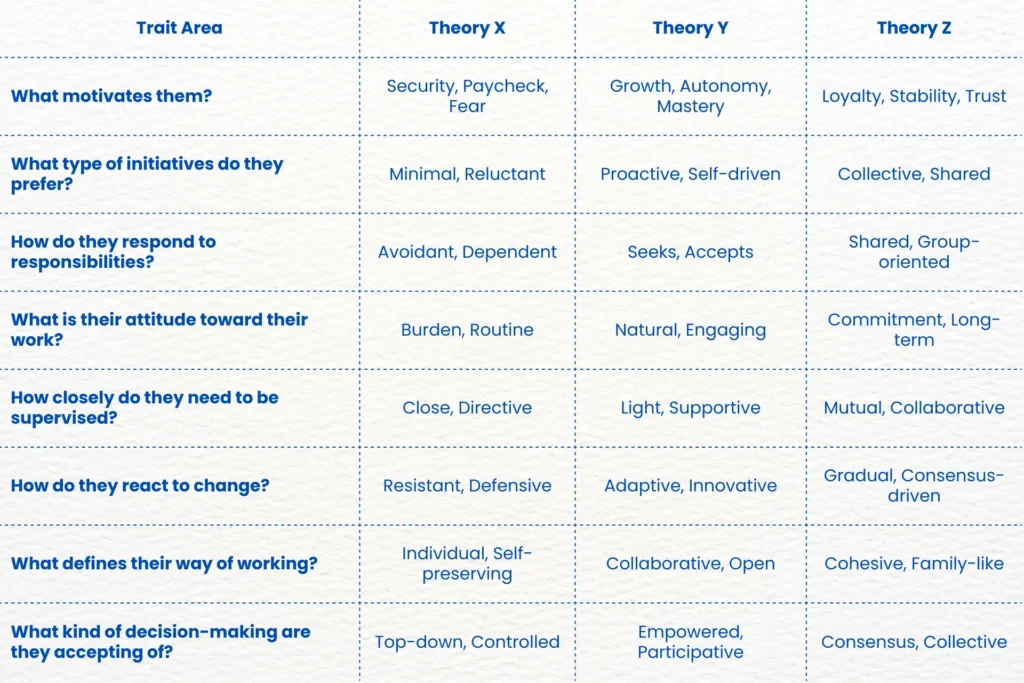
To help you make the most of this article and use in future references, I have tried to summarize the answer in the form of a table below. This table presents you with qualities to look for in different stakeholders and be able to conclude how to manage them well – micromanage, let them flow, or help feel as part of a family.
Theory XYZ Categorization ● Created original by Aakash Sharma
And finally… how to manage them all in a single project environment?
Now that we know how to identify the different types of people we come across while working, the next part is to know how to handle them, to help them perform their best. We, as leaders, need to accept the fact that not everybody reacts the same way to an action. So, as we share information, communicate, try to collaborate, we need to do so in a manner that does not offend or demotivate one person while inspiring another. How do we do this?
Here’s a step-by-step process for all you folks!
Step 1: Identify which individuals in your project environment can be assumed under Theory X, Y, and Z.
Step 2(a): If they fall under Theory X (trust level – low; avoid responsibility):
Provide a clear structure to work along: defined tasks, timelines, and expectations.
Keep communication direct and instruction-based for proper alignment.
Create accountability systems to track their efforts via trackers, dashboards, and standups.
Step 2(b): If they fall under Theory Y (trust level – high; self-driven):
Treat them as partners rather than associates reporting to you. Use open, two-way communication for encouragement.
Involve them in decision-making and problem-solving for best project handling experience.
Motivate them by providing skill-level matching growth opportunities, recognizing their efforts, and show authentic trust.
Step 2(c): If they fall under Theory Z (trust level – high; value long-term growth & balance):
Emphasize team harmony and collective goals over individual competition.
Show genuine concern for their well-being and career growth.
Promote work-life balance and personal growth opportunities via group activities like team outings, training programs for skill development, and handing recognition as a team.
Step 3 (Most Important): Regardless of which theory they fall under, act as a leader and adapt people-centric attitude to provide a positive work environment.
Make all stakeholders feel welcome to share their opinions and ideas.
Help team members feel part of the team than focusing on a select few based on your personal bias.
Refrain from sharing negative feedback unless it directly affects the project or they ask for it.
Refrain from commenting on their work styles or they manage their time. Freedom over authority leads to better inspired teams.
When you balance structure, trust, and care, you stop being just a manager who extracts output — you become a leader who unlocks potential. And that’s how you turn friends, enemies, and even the so-called ‘pains’ into allies for success.
👉 So what do you think? Have you seen these patterns play out in your own projects? Drop your thoughts in the comments. And if you found this perspective useful, you can check out more of my writings on my blog or subscribe to the newsletter for deeper dives.
A nation is built by its people. To grow a nation, its people must feel free. And to feel free, we must have the courage to ask for what is ours.
This Independence Day, pledge to ask for what you deserve. To breathe the fresh air of freedom, savor the aroma of self-respect, and look up at a clear blue sky that mirrors the happiness you are entitled to.
Free yourself from the chains of toxicity, micromanagement, and overwork, tied on by corporates in the name of “putting food on your table”. Ask for what you feel is right.
●
Free yourself from the blindfold placed by governments in the name of religion and god – a tool to pull money unethically through taxes.
●
Free your mind from the knots that force you to move with the crowd under the excuse of “That’s how the world works!” Know what is right, and take a stand for it, even when the path is rough.
●
Free your impulse from societal pressure to raise a family, buy a house, stack up investments – all to “secure your future” while forgetting to live. Instead, appreciate nature. Acknowledge all these beautiful animals we’re surrounded by, that teach life’s lessons better than most humans. Protect the environment. And with it, humanity, instead of selfishly protecting only your tomorrow.
●
Free your hands from the ropes that tie you to earning money at any cost. Nurture your passions, use your skills, and create something original and meaningful that contributes to the world.
●
Freedom is not just a day on the calendar; it’s a choice you make daily. Be the change you wish to see in the world. 🩵