
Part of the series The Decipherer: Unraveling PM for you
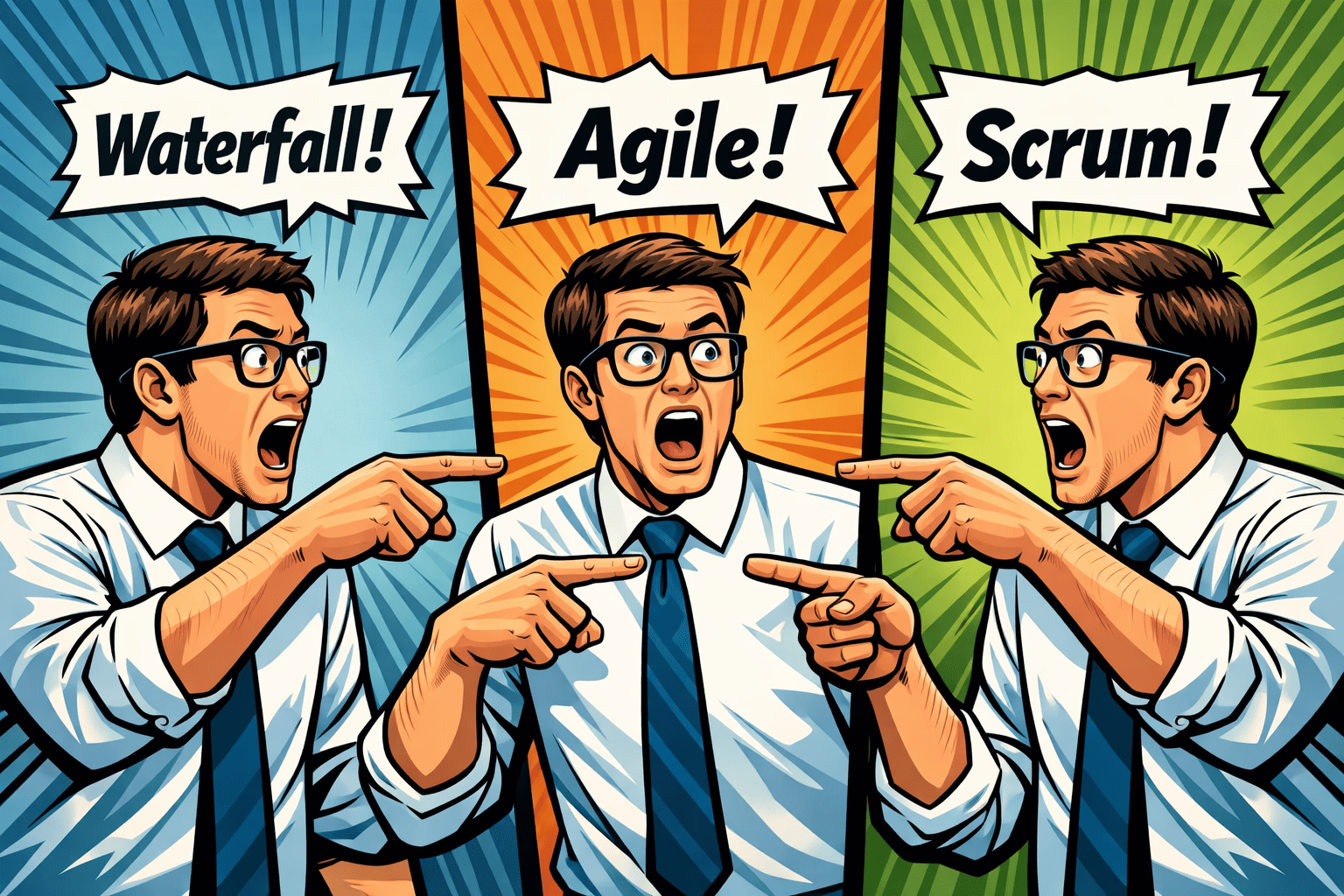
Every Project or Product Management enthusiast eventually crosses paths with these three beautiful concepts — Waterfall, Scrum, and Agile.
These concepts provide not only new learnings but entirely new ways to shape your thought process. Some fall in love with Waterfall for its structural discipline, while others develop a crush on Agile and its ability to keep work light. Those in a relationship with software or data? Well, they are usually out on a non-optional date with Scrum, set up by their mentors.
Yet, in all my conversations over the years 🤓 — whether interviewing candidates, mentoring PMs, coaching aspiring Project and Program Managers, or reviewing professional resumes 📝 — I have found the following statements to be alarmingly common:
- “My area of expertise includes Agile & Waterfall methodologies.“
- “My core strengths are Scrum & Agile methods.“
- “I use the Agile framework in my workplace.“
- “In Agile projects, we use artifacts like Daily Standups and Sprint Backlogs.“
Do you hear such statements often? Or perhaps, do you use them yourself?
What if I told you that every single one of these sentences is absolutely incorrect? Some of you might find this surprising, while the seasoned veterans are likely nodding in agreement.
Let’s see why!
What separates a top-tier Program Manager from an average one isn’t the size of the budget or the type of project they own. It is how they think during execution. It is the way they prioritize action items and how efficiently they command the resources at hand.

Here is the mantra:
WATERFALL is the way we plan.
AGILE is the way we think.
SCRUM is the way we act.
Curious to know the difference?
Let me break down the technical side for you—stress-free and simple.
METHODOLOGY.
PHILOSOPHY.
FRAMEWORK.
These three concepts are often overlooked. Yet, trust them to be the silent architects of your success when given deep thought in the early stages of any project.
Methodology is the sanctuary for those who crave order; who love to keep things organized. It defines a comprehensive, well-structured approach—and it delivers exactly what it promises. A methodology provides a map, detailed processes, procedures, and the specific tools required to reach the destination.
Let’s look at a real-world example as a fun project!

Say, it is your girlfriend’s birthday next week and you are to buy her a present. You open the Amazon app to find the perfect gift. Would you agree that the app builds the road for you step-by-step: from an intuitive search bar to the product selection, to the cart, to the payment gateway, and finally, the delivery tracking. The experience flows in a systematic, non-negotiable manner. And that system is what makes our experience so great that we’re addicted to online shopping.
- Does the app allow you to pay for the order before adding the product to the cart?
- Does it let you claim the cashback reward before you actually make the purchase?
No. That is exactly what a Methodology offers: An organized system where you follow a pre-determined pattern, leaving no room for loopholes. You can only move to Step B after Step A is complete.
Read these points. If your current way of working matches them, you are using a Methodology:
- It provides detailed, step-by-step guidance to manage the project.
- It clearly defines phases in a project, strict set of tasks, individual roles & responsibilities, and deliverables.
- It comprehensively covers the aspects of management that otherwise keep a manager up at night: from Planning → Execution → Closure.
Which keyword crossed your mind when you read those features?
Take a second. Think about it.
The first concept that likely hit you is Waterfall.
Other methodologies that have ruled industries for decades include PRINCE2, Six Sigma, and Critical Chain Project Management (CCPM).
Haven’t heard of all of them? Don’t worry. Your curiosity will lead you there soon enough. For now, just focus on how Waterfall fits the strict criteria we just defined.
The next brilliant category… Philosophy!
This one is my personal favorite, and I think you will agree on the why.
Philosophy is the way our mind works.
A common saying you might have heard is, “To each their own.” That is exactly what this category allows us to realize in professional environments: The way we manage our work is predicated on how we think, the values we live by, and the mindset with which we approach a problem.
Out of the three, Philosophy is generally the love of those with a creative mind. Why? Because there are no rules or boundaries when the requirement is to think. In fact, you are expected to widen your horizons.
Let’s go back to a real-world scenario.
Imagine you love coffee so much that you have mastered the craft of brewing the perfect latte. Now the entrepreneur in you decides it is time to open a cafe and share that perfect cup with the world. You feel you can make millions with this idea!
But is having a “vision” enough to achieve success?
If I were the one with this idea, I would broaden my mind. I wouldn’t just think about my perfect cup; I would think about and scope out the customer’s thoughts.
- Is a latte all they want?
- What if they prefer a cold brew or a quick espresso shot?
- Should I buy a coffee machine or hand-press every cup?
- What if the latte stops selling? Should I experiment by selling cookies to create a combo?
The thoughts, ideas, questions, risks, and doubts—everything is limitless.
That is what a Philosophy does. It shows us the way and shapes our decisions. The Methodology we eventually choose comes from how well we think about the project first.
Features to expect include:
- Values over Instructions: Philosophy provides overarching beliefs rather than specific steps.
- Behavior over Process: It shapes how we approach a project, focusing on attitude rather than the rulebook.
- The Foundation: It serves as the bedrock for selecting the right Methodology and Framework.
The best example of this category is Agile—a flexible mindset ready to take on challenges as they come. Other philosophies that are just as significant include Lean, Kaizen, and Servant Leadership.
The last of the three—Framework—neither gives you strict instructions nor complete freedom. I bet you’d love to know what it offers to us then!
Think of a framework as a Mentor.
A mentor is not there to force a rigid thought process on you. Instead, they guide you toward your goals by showing you the path, leaving you free to make wise choices about how to walk it.
In Project Management terms, a framework provides a diverse toolkit of practices to help execute a project. It is then up to our Mindset (Agile) to select which tool is the right choice to handle the workflow smoothly.
Consider the reality of a corporate job:
- One organization might succeed with just 1 PM handling execution for a non-technical project.
- Another might need a full PMO team, a Product Owner, and an Agile Lead to handle a large-scale deployment.
A Framework accommodates both. Some of the key features you may expect:
- Guidelines, not Chains: It provides team roles, tools, templates, and guidelines without dictating specific, micromanaged steps.
- Customization: With no fixed instructions, it allows us to customize our way of working based on the team size and environment.
- The “Pack”: It offers a well-established set of events, cadences, and artifacts (like Standups or Boards) while leaving room for interpretation.
Some of the highly recognized frameworks include Scrum, Kanban, Crystal, SAFe, Scrum of Scrums (SoS), and Disciplined Agile.
But here is the catch: A framework is only as good as its fit.
Scrum is a powerful engine for a software team, but it might stall if I used it to manage a simple, linear task like organizing a school’s annual day function. Similarly, standard Scrum works wonders for a team of 7, but chaos ensues if applied blindly to a group of 100 associates.
This is the true power of frameworks: They offer us choices.
We don’t serve the framework; the framework serves us. It allows us to pick the right structure for our specific team size, complexity, and goals.
So, would you still call yourself an expert of Agile? 😉
OR, use Scrum and Agile in the same sentence as if they are equals?
Let’s look at those resume statements one last time.
The sentence “My area of expertise includes Agile & Waterfall methodologies” is incorrect ❌ because Agile is not a method—it is a thinking style. You cannot claim “expertise” in a mindset the same way you claim expertise in a tool.
The sentence “In Agile projects, we use Daily Standups and Sprint Backlogs” is incorrect ❌ because those events and artifacts are the contributions of a Framework (Scrum), not the values of a Philosophy (Agile).
Are Agile and Waterfall equals? Can they be listed as a single skill line on your resume?
NO. ❌
They are not alternatives; they are different dimensions.
- Agile is a Mindset: A strategic philosophy for navigating the unknown, prioritizing adaptability and value.
- Waterfall is a Methodology: A rigid, pre-defined route for certainty.
Using Waterfall in an unpredictable environment is like trying to use a printed city map to navigate through a jungle. It offers false certainty in an environment that demands agility.
Do you agree? If you are aiming to become a professional Project Manager, these distinctions are not just “theory”—they are critical to your survival and success.
Share your thoughts, questions, or your own “resume horrors” in the comments for a fun conversation! 😁💯
I am Aakash Sharma, and the mission of The Lion Among Sheep is to bridge the gap between textbook theory and real-world dominance.
If you are ready to stop following the herd and start leading the pack, I am here to help.
- For Professionals: I offer 1:1 Mentoring, Coaching, and strategic preparation for Professional Exams (PMP, Agile) to help you accelerate your career.
- For Businesses: I act as a Strategic Consultant, helping organizations bring structure to chaos and optimize their ways of working for maximum efficiency.
Visit the Services Page to explore how we can work together.